


GOODS/ISAAC Final Data Release: Version 2.0
10 September 2007
As part of the Great Observatories Origins Deep Survey (GOODS), near-infrared imaging observations of the Chandra Deep Field South (CDF-S) were carried out in J, H, Ks bands, using the ISAAC instrument mounted at the Antu Unit Telescope of the VLT at ESO's Cerro Paranal Observatory, Chile.
These data were obtained as part of the ESO Large Programme 168.A-0485 (PI: C. Cesarsky). Data covering four ISAAC fields in J and Ks bands were also drawn from the ESO programmes 64.O-0643, 66.A-0572 and 68.A-0544 (PI: E.Giallongo), which were part of the previous data releases.
This data release includes 26 fully reduced and calibrated VLT/ISAAC fields in J and Ks bands, and 24 fields in H band, covering 172.4, 159.6, and 173.1 arcmin2 of the GOODS/CDF-S region, respectively, as well as three mosaics in J, H and Ks. More than 50% of the images reach a 5-sigma depth for point sources of at least 25.2 mag (J), 24.7 mag (H and Ks) in the AB system ("median depth").
This final GOODS/ISAAC data release accumulates observational data which have been acquired in 12814 science integrations between October 1999 and January 2007 totaling 1.3 Msec integration time. Consequently, it supersedes all previous GOODS/ISAAC data releases. The raw data is publicly available from the ESO Science Archive Facility.
New in this release are the data obtained in ESO observing periods P76 and P78, namely two new tiles in J and Ks, 5 new tiles in the H band. Data reduction procedures and the calibration strategy have been enhanced resulting in data quality improvements and more accurate photometric and astrometric calibration with respect to the previous release. The data were reduced and prepared for release by the Advanced Data Products group in the Virtual Observatory Systems department.
A comprehensive account of the content and properties of the data set including a Ks-selected color catalog and galaxy number counts results is presented in the accompanying publication "The Great Observatories Origins Deep Survey - VLT/ISAAC Near-Infrared Imaging of the GOODS-South Field" by Retzlaff et al. (2010). Please find the JHKs catalog of 7079 sources as discussed in Retzlaff et al. (2010) for direct download at this URL [FITS binary table format].
See also the related, new data release from 02 March 2010, VLT/ISAAC Ks-band imaging of the Hubble Ultra Deep Field (v1.0)
Overview and field layout
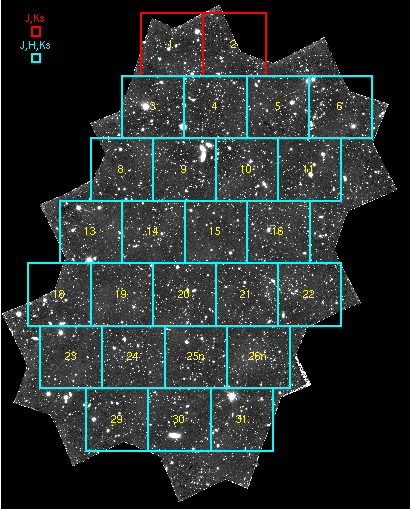 |
The mosaic of ISAAC tiles included in this release is overlaid on the HST/ACS GOODS z-band mosaic: 24 tiles in the J, H and Ks bands (cyan), plus 2 additional tiles in J and Ks (red). Each ISAAC field is 2.5 arcmin across. Get full size image. |
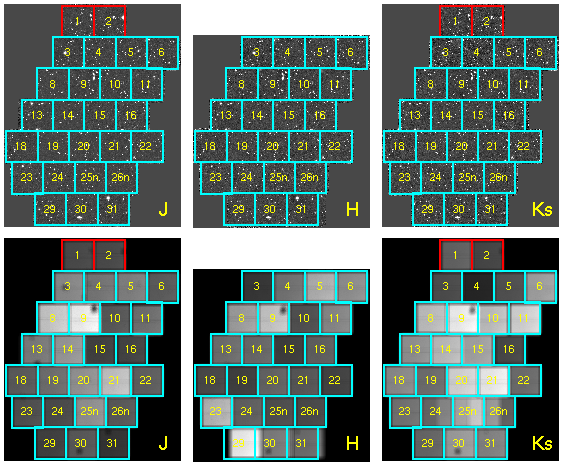 |
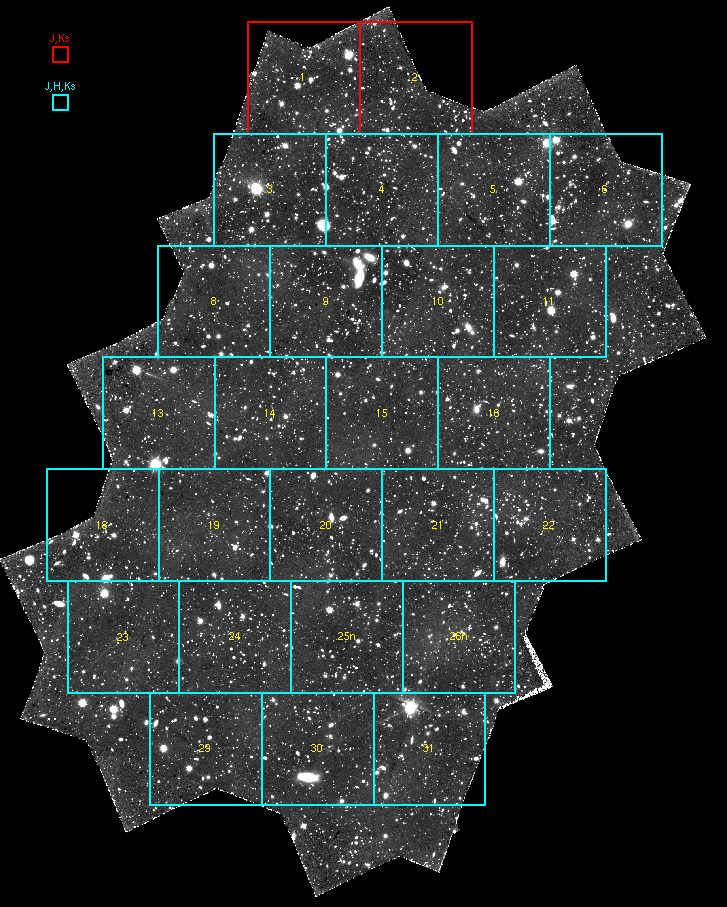
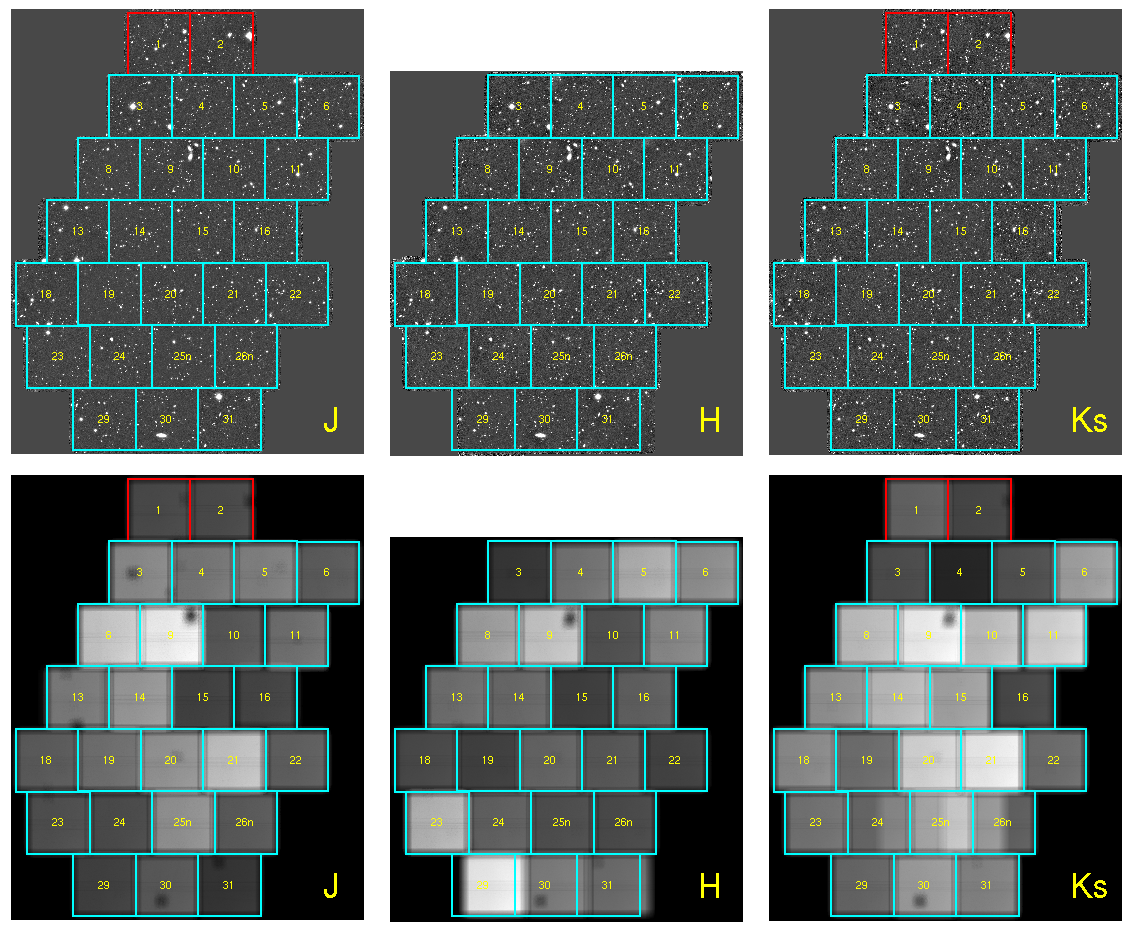
Mosaic image for each band (J, H, and Ks) and the respective weightmap with field layouts. Get full size image. |
Release content
Summary of reduced ISAAC fields
The 78 images being released are tabulated below, consisting of 28 images in J, 24 in H, and 28 in Ks band, astrometrically and photometrically calibrated. The table gives: in column (1) the field number; in column (2) the passband; in column (3) the total integration time in seconds; in column (4) the number of frames that make up the final image; in columns (5) and (6) the period of observations; in column (7) the seeing measured as the average FWHM of stellar sources in arcsec; in column (8) the depth being defined as the total AB magnitude of a point source corresponding to the 1-sigma sky fluctuation of the flux within circular apertures. Obtain the 5-sigma depth by subtracting 1.75 mag. The same table is also available in ASCII format with Tab-separated values.
In addition, we release for convenience the full mosaic of all ISAAC tiles in J, H and Ks bands (see figures above) with an accurate astrometric solution and uniform photometric zero point (however, read the notes below).
| Field | Band | Exptime | Ncombine | ObsStart | ObsEnd | Seeing | Depth |
|---|---|---|---|---|---|---|---|
| (1) | (2) | (3) | (4) | (5) | (6) | (7) | (8) |
| F01 | J | 10560 | 88 | 2005-12-25 | 2006-01-12 | 0.60 | 26.69 |
| F01 | Ks | 17910 | 199 | 2005-12-25 | 2006-01-14 | 0.50 | 26.26 |
| F02 | J | 10920 | 91 | 2006-02-13 | 2006-02-16 | 0.59 | 26.76 |
| F02 | Ks | 14040 | 156 | 2005-11-19 | 2005-11-21 | 0.56 | 26.14 |
| F03 | J | 12600 | 105 | 2002-11-07 | 2003-10-21 | 0.43 | 27.03 |
| F03 | H | 17880 | 149 | 2005-01-19 | 2005-01-27 | 0.54 | 26.04 |
| F03 | Ks | 20340 | 226 | 2003-10-19 | 2004-02-10 | 0.49 | 26.03 |
| F04 | J | 12480 | 104 | 2003-10-06 | 2003-10-20 | 0.45 | 26.97 |
| F04 | H | 25200 | 210 | 2003-10-17 | 2004-02-03 | 0.47 | 26.46 |
| F04 | Ks | 9810 | 109 | 2003-10-17 | 2003-10-18 | 0.51 | 25.84 |
| F05 | J | 12360 | 103 | 2002-12-26 | 2003-01-17 | 0.39 | 27.07 |
| F05 | H | 17520 | 146 | 2004-12-23 | 2005-09-19 | 0.40 | 26.82 |
| F05 | Ks | 16200 | 180 | 2002-12-23 | 2003-12-05 | 0.56 | 26.12 |
| F06 | J | 14400 | 120 | 2004-11-25 | 2005-01-18 | 0.42 | 26.92 |
| F06 | H | 18000 | 300 | 2006-11-08 | 2007-01-03 | 0.37 | 26.65 |
| F06 | Ks | 21330 | 237 | 2004-10-28 | 2004-11-25 | 0.40 | 26.59 |
| F08 | J | 11880 | 99 | 2003-10-04 | 2003-10-21 | 0.45 | 27.33 |
| F08 | H | 16800 | 140 | 2003-02-18 | 2004-01-29 | 0.37 | 26.72 |
| F08 | Ks | 21510 | 239 | 2002-12-17 | 2003-02-15 | 0.38 | 26.59 |
| F09 | J | 12600 | 105 | 2001-11-06 | 2001-11-21 | 0.40 | 27.26 |
| F09 | H | 18000 | 150 | 2001-11-07 | 2001-12-20 | 0.40 | 26.70 |
| F09 | Ks | 21510 | 239 | 2001-10-01 | 2001-11-16 | 0.42 | 26.67 |
| F10 | J | 11880 | 66 | 2000-10-14 | 2000-11-12 | 0.52 | 26.84 |
| F10 | H | 18120 | 151 | 2001-12-20 | 2001-12-26 | 0.49 | 26.44 |
| F10 | Ks | 23800 | 238 | 2000-10-11 | 2001-01-04 | 0.46 | 26.64 |
| F11 | J | 11520 | 64 | 2000-11-13 | 2000-11-13 | 0.49 | 27.02 |
| F11 | H | 17760 | 148 | 2001-12-21 | 2001-12-26 | 0.48 | 26.65 |
| F11 | Ks | 30900 | 309 | 2000-11-13 | 2002-01-18 | 0.47 | 26.69 |
| F13 | J | 10800 | 90 | 2002-10-26 | 2002-12-26 | 0.41 | 27.04 |
| F13 | H | 14400 | 120 | 2002-11-29 | 2002-11-29 | 0.50 | 26.51 |
| F13 | Ks | 21150 | 235 | 2002-10-26 | 2002-12-26 | 0.45 | 26.53 |
| F14 | J | 12600 | 105 | 2001-11-06 | 2001-11-19 | 0.43 | 27.19 |
| F14 | H | 14280 | 119 | 2001-09-30 | 2001-12-19 | 0.42 | 26.57 |
| F14 | Ks | 21690 | 241 | 2001-09-30 | 2001-11-14 | 0.46 | 26.68 |
| F15 | J | 11340 | 63 | 2002-01-19 | 2002-02-13 | 0.49 | 26.76 |
| F15 | H | 17880 | 149 | 2001-12-25 | 2002-01-15 | 0.65 | 26.20 |
| F15 | Ks | 27100 | 271 | 2002-01-21 | 2002-02-13 | 0.52 | 26.59 |
| F16 | J | 10620 | 59 | 1999-10-28 | 1999-11-17 | 0.44 | 26.79 |
| F16 | H | 17760 | 148 | 2001-12-26 | 2002-01-15 | 0.54 | 26.48 |
| F16 | Ks | 30100 | 301 | 1999-10-21 | 1999-10-25 | 0.53 | 25.89 |
| F18 | J | 18000 | 150 | 2004-11-26 | 2005-02-25 | 0.50 | 26.83 |
| F18 | H | 14520 | 242 | 2006-12-07 | 2007-01-04 | 0.57 | 26.26 |
| F18 | Ks | 21600 | 240 | 2004-10-31 | 2004-11-25 | 0.42 | 26.48 |
| F19 | J | 16200 | 135 | 2002-09-15 | 2002-09-23 | 0.62 | 26.91 |
| F19 | H | 17280 | 144 | 2005-01-20 | 2005-08-22 | 0.61 | 26.23 |
| F19 | Ks | 20160 | 224 | 2002-01-25 | 2002-02-16 | 0.51 | 26.32 |
| F20 | J | 12600 | 105 | 2001-11-13 | 2001-11-22 | 0.46 | 27.21 |
| F20 | H | 17640 | 147 | 2001-12-27 | 2002-01-16 | 0.51 | 26.51 |
| F20 | Ks | 21510 | 239 | 2001-11-13 | 2001-11-21 | 0.39 | 26.76 |
| F21 | J | 15120 | 126 | 2001-11-06 | 2001-11-24 | 0.40 | 27.33 |
| F21 | H | 13800 | 115 | 2001-12-27 | 2001-12-31 | 0.47 | 26.42 |
| F21 | Ks | 21420 | 238 | 2001-11-07 | 2001-11-19 | 0.38 | 26.76 |
| F22 | J | 15000 | 125 | 2003-01-21 | 2003-02-12 | 0.55 | 26.80 |
| F22 | H | 17520 | 146 | 2003-02-05 | 2003-02-11 | 0.52 | 26.25 |
| F22 | Ks | 21150 | 235 | 2003-01-13 | 2003-01-26 | 0.53 | 26.27 |
| F23 | J | 9000 | 75 | 2004-01-04 | 2004-01-14 | 0.46 | 26.85 |
| F23 | H | 14040 | 117 | 2004-12-24 | 2004-12-26 | 0.34 | 26.78 |
| F23 | Ks | 21420 | 238 | 2004-01-14 | 2004-02-16 | 0.45 | 26.44 |
| F24 | J | 9840 | 82 | 2002-10-17 | 2003-10-21 | 0.54 | 26.83 |
| F24 | H | 17760 | 148 | 2004-11-17 | 2004-11-27 | 0.42 | 26.48 |
| F24 | Ks | 20880 | 232 | 2002-10-11 | 2003-10-21 | 0.50 | 26.32 |
| F25 | Ks | 7110 | 79 | 2002-01-23 | 2002-02-17 | 0.58 | 25.59 |
| F25n | J | 12600 | 105 | 2002-09-24 | 2002-10-08 | 0.52 | 27.12 |
| F25n | H | 14280 | 119 | 2004-11-28 | 2005-01-27 | 0.46 | 26.39 |
| F25n | Ks | 21600 | 240 | 2002-09-15 | 2002-10-06 | 0.42 | 26.45 |
| F26 | Ks | 10440 | 116 | 2002-01-13 | 2002-01-25 | 0.48 | 26.00 |
| F26n | J | 12240 | 102 | 2002-09-24 | 2002-10-15 | 0.56 | 26.86 |
| F26n | H | 18000 | 150 | 2004-11-27 | 2004-11-28 | 0.51 | 26.28 |
| F26n | Ks | 21240 | 236 | 2002-09-24 | 2002-10-10 | 0.57 | 26.29 |
| F29 | J | 9000 | 75 | 2004-02-02 | 2004-09-01 | 0.60 | 26.70 |
| F29 | H | 18060 | 301 | 2006-09-13 | 2006-11-03 | 0.41 | 27.03 |
| F29 | Ks | 16650 | 185 | 2004-02-12 | 2004-08-01 | 0.49 | 26.35 |
| F30 | J | 12360 | 103 | 2003-11-17 | 2004-01-01 | 0.59 | 26.84 |
| F30 | H | 15180 | 253 | 2006-09-15 | 2006-11-06 | 0.46 | 26.56 |
| F30 | Ks | 24210 | 269 | 2002-12-22 | 2004-02-02 | 0.41 | 26.50 |
| F31 | J | 10800 | 90 | 2004-02-21 | 2004-03-03 | 0.57 | 26.61 |
| F31 | H | 16920 | 282 | 2006-09-15 | 2006-09-24 | 0.61 | 26.40 |
| F31 | Ks | 21060 | 234 | 2003-12-30 | 2004-03-09 | 0.41 | 26.36 |
Outlines of all ISAAC tiles can be overlaid onto any image with WCS information using this DS9 region file.
Comparison to previous releases
This is the fourth and final data release of the ESO GOODS/ISAAC survey. It revises and significantly extends the previous release version 1.5 of September 30, 2005.
The first release version 0.5 consisted of 8 fields in J, H and Ks (Fields 09, 10, 11, 14, 15, 16, 20, 21). The second release version 1.0 consisted of a new reduction of these same 8 fields, with the addition of 13 new fields in J band and 15 new fields in Ks. The third release (v1.5) contained 3 new fields in J and Ks bands (Fields 06, 18, and 29) and 19 new fields in H band. The present release contains 2 new fields in J and Ks bands (Fields 01 and 02), and 5 new tiles in the H band (Fields 06, 18, 29, 30 and 31). Additionally, one hour of integration time each has been added to Fields 05 and 19 in H band due to the completion of those integrations in ESO observing period P76. Furthermore this release also includes the re-reduced data of all the previously released fields which benefit from significant improvements in data reduction and calibration procedures (see below). Therefore the present release supersedes all the previous GOODS/ISAAC data releases v0.5, v1.0, and v1.5.
Note the suffix 'n' (new) for the fields 25n and 26n is due to a re-arrangement of the ISAAC mosaic in the initial stage of survey to ensure maximum coverage of the GOODS/CDF-S area within the time allocation. Reduced observations in the original field positions (as part of programme ID 168.A-0485(E)) are also included in this release (~5 hours in Ks band only in fields named F25,26).
The main areas of improvements in this release in terms of data reduction and calibration procedures are:
- ESO/MVM version 1.3.4 has been used for the data reduction which fixes a number of bugs and contains enhancements, most notably:
- The procedure for the rejection of defective sky flats has been made more robust and more reliable.
- The order of the astrometric solution has been raised to order 3 which significantly reduces astrometric residuals down to about 50 MAS RMS over the whole instrumental field of view.
- The number of sky flats being used in the data reduction has been increased in order to minimize the time lag between science and calibration frames. This has basically affected and improved the removal of instrumental signatures for a number of the observations acquired between 1999 and 2004.
- The absolute photometric calibration is based on observations of flux standard stars. In addition, a set of 5'x5' images obtained with the SOFI instrument as part of the ESO Imaging Survey and re-reduced with MVM v1.3.4 has been used to ensure photometric homogeneity across the whole survey area.
- Refined quality control procedures taking into account the measured sky background noise and photometric properties of the reduction blocks.
- The final co-addition of images and mosaics employs a weighting scheme which takes into account (besides the weight map) the zero point scaling of individual images, the measured noise amplitude and pixel-to-pixel correlations of the noise.
- The conversion to AB magnitudes makes use of updated information on instrumental throughput for ISAAC (find AB corrections below, or go directly to the Virtual Observatory Systems mag2flux conversion utility).
Note that new AB corrections which have been applied in this release account for a shift in AB magnitudes of 0.060 (J), 0.046 (H), and 0.035 (Ks) with respect to the previous release (version 1.5) meaning that sources appear fainter in the present data set. Photometric comparison reveals an average shift of 0.04 and 0.035 mag in addition to the AB correction difference in J and Ks, respectively. This shift can be ascribed to the ZP of the mosaic of SOFI images which were used to bootstrap ISAAC ZPs for the previous release. In fact, a direct photometric comparison of this data (in Ks) with the new absolute calibration using flux standards confirms an average shift at the few percent level (in Ks). ZPs in H band were subject to much larger uncertainties than in J and Ks in the previous release. Therefore H band ZP differences appear to be more scattered and do not exhibit a significant shift.
Comparison of this and the previous release in terms of limiting magnitude (computed from the measured sky background noise within circular apertures) shows that this release appears to be slightly deeper than the previous one. Actually, 50% of the stacked images are at least deeper by about 0.025 mag (J), 0.088 mag (H), and 0.050 mag (Ks) in this release. Note, that the ZP shift as mentioned in the previous paragraph has been compensated for, i.e. these numbers refer to a common zero point. This depth gain can be explained as a result of the coaction of a number of improvements being made for this release: (a) refined flat field correction (better rejection of defective sky flats and reduction of time lag between science frame and sky flat calibration frames), (b) rejection of low quality data being strictly based on QC parameters, and (c) weighting scheme taking into account zero point scaling, measured noise amplitude and correlations (cf. list of changes above).
The more stringent rejection of reduction blocks (RB) based on the average FWHM of stellar sources (seeing) and the measured sky background noise results in a significant reduction of total exposure time for the stacked images F04.Ks, F14.H, and F24.J by 26%, 19%, and 20%, respectively. However, the limiting depth decreases just marginally for F04.Ks (by -0.02 mag), it even increases for F14.H (by 0.09 mag), while being consistent with the exposure time decrement for F24.J (-0.12 mag). Since the rejected RBs are subject to unusually high noise, the photometric uniformity over the images has been improved.
Release Notes
Data reduction method
The ISAAC data were reduced using an improved version of the ESO/MVM image processing pipeline (version 1.3.4), developed by B. Vandame until Dec'06 as an extension of the original development within the EIS project. This software package is publicly available in the version 1.3.5 from this URL with a configuration file for the ISAAC instrument which is equivalent to the one which was used for the reduction of this survey data release.
Each field is the co-addition of a number of sky-subtracted frames (NCOMBINE in the image header) grouped in a number of Reduction Blocks.
The fully automated processing of the entire data set of 13964 raw science images, 20699 calibration frames, and 6290 photometric standards with MVM on two CPUs of a 2.0 GHz AMD Athlon MP 2400 runs for less than 10 hours.
Astrometric Calibration
The astrometric calibration was derived using a reference catalog generated from a deep R-band ESO Wide Field Imager (WFI) image of the CDF-S which was astrometrically calibrated using the Guide Star Catalog GSC2.3.
The rms astrometric scatter for high SNR sources (AB between 17 and 19 mag) is 0.05" in all three bands.
The astrometry has been compared by the GOODS team with calibrated data from the Hubble Space Telescope (HST) Advanced Camera for Surveys (ACS). These comparisons yield rms scatter in astrometry of 0.1'' across the entire area.
All images have a pixel scale of 0.15", which is exactly a factor of five larger than the pixels in the GOODS/ACS images.
Photometric calibration
Photometric zero points (ZP) of the present data are based on 184 observations of flux standard stars obtained together with the respective science observations over the entire period. Data without a reliable ZP from flux standards have been rescaled according to a measured photometric scaling. In addition a set of SOFI images (5'x5' each) covering the CDF-S region has been employed to equalize the photometric calibration over the whole survey area. The measurement of photometric scaling between two images is always preceded by the appropriate PSF matching procedure in order to avoid aperture correction bias. The optimal global photometric solution (in a least-square sense) is computed from the photometric calibration input (ZPs and photometric scalings) per band with resulting 2-sigma ZP uncertainties of 0.030 mag (J), 0.023 mag (H), and 0.034 mag (Ks).
However, note that to provide a homogeneous photometric ZP across the entire GOODS field, we have rescaled all images to the same ZP of 26.0 in the AB system. Corresponding keywords in the fits headers have been set accordingly, PHOTZP=26.0, PHOTSYS=AB, and PHOTZPER. The exposure times are normalized to unity (EXPTIME=1), so that AB magnitudes in all released fields, including the mosaics, can be obtained as: mag(AB)=-2.5*Log(flux)+ZP. The following AB corrections have been used: JAB=JVega+0.960, HAB=HVega+1.426, and Ks,AB=Ks,Vega+1.895.
The photometric calibration of this data set was found to be consistent with 2MASS photometry of stellar sources. Due to the restricted overlap in magnitudes the accuracy of this test is limited by random errors in 2MASS photometry to about 0.05 mag.
Image Mosaics
In addition to the individual image tiles, this release also includes mosaics of the co-adjoined tiles as single fits files in J, H and Ks bands, as well as corresponding weight-maps. The WCS information and accuracy of the individual tiles is preserved in these mosaics. A uniform ZP of 26.0 can be used (e.g. with SExtractor) across the entire field, however, it is important to note that the PSF varies from tile to tile within each mosaic (see table). In the absence of proper aperture corrections or PSF matching procedures, this would lead to biases when creating multi-color catalogs. The J, H and Ks mosaics have slightly different dimensions, however they can be readily registered using the intrinsic WCS information.
Data format
The data files in this release come in pairs: one is the science frame, the second one is the corresponding weight map (*.weight.fits) defined as a variance map (e.g. it should be used with SExtractor using the parameters: -WEIGHT_IMAGE weight_map.fits -WEIGHT_TYPE MAP_WEIGHT). All relevant parameters are included in the FITS headers (see a sample here) which have been changed with respect to the previous release in order to be consistent with future VO compliant releases of ESO Advanced Data Products.
The following file naming convention has been adopted:
GOODS_ISAAC_xx_b_v2.0.fits
GOODS_ISAAC_xx_b_v2.0.weight.fits
for the field number <xx> in the band <b> and the respective weight map;
GOODS_ISAAC_mosaic_b_v2.0.fits
GOODS_ISAAC_mosaic_b_v2.0.weight.fits
for t`he mosaic image in the band <b> and the respective weight map.
Additionally, field names can be found in the OBJECT keywords in the FITS headers.
Data retrieval
Please make your selection on the page linked to below.
| Package | Description | Size |
|---|---|---|
| Entire dataset | 162 FITS files | 1.6 GB |
Acknowledgements
When using data products provided in this release, we request acknowledgement of the ESO/GOODS project and referring to the related publication Retzlaff et al. (2010), which describes quality control procedures, characterizes the survey data in more detail and presents first results.
Please also use the following statement in your articles when using these data "Observations have been carried out using the Very Large Telescope at the ESO Paranal Observatory under Programme ID 168.A-0485".